Introduction
Lipid nanoparticles have become one of the most important drug delivery technologies in modern medicine. After more than six decades of research and development, they entered the global spotlight as the delivery system behind the COVID-19 mRNA vaccines—but their potential extends far beyond vaccines. Understanding what LNPs are, how they work, and what limits their effectiveness is essential context for anyone following advances in gene therapy, cancer treatment, and precision medicine.
What is a lipid nanoparticle?
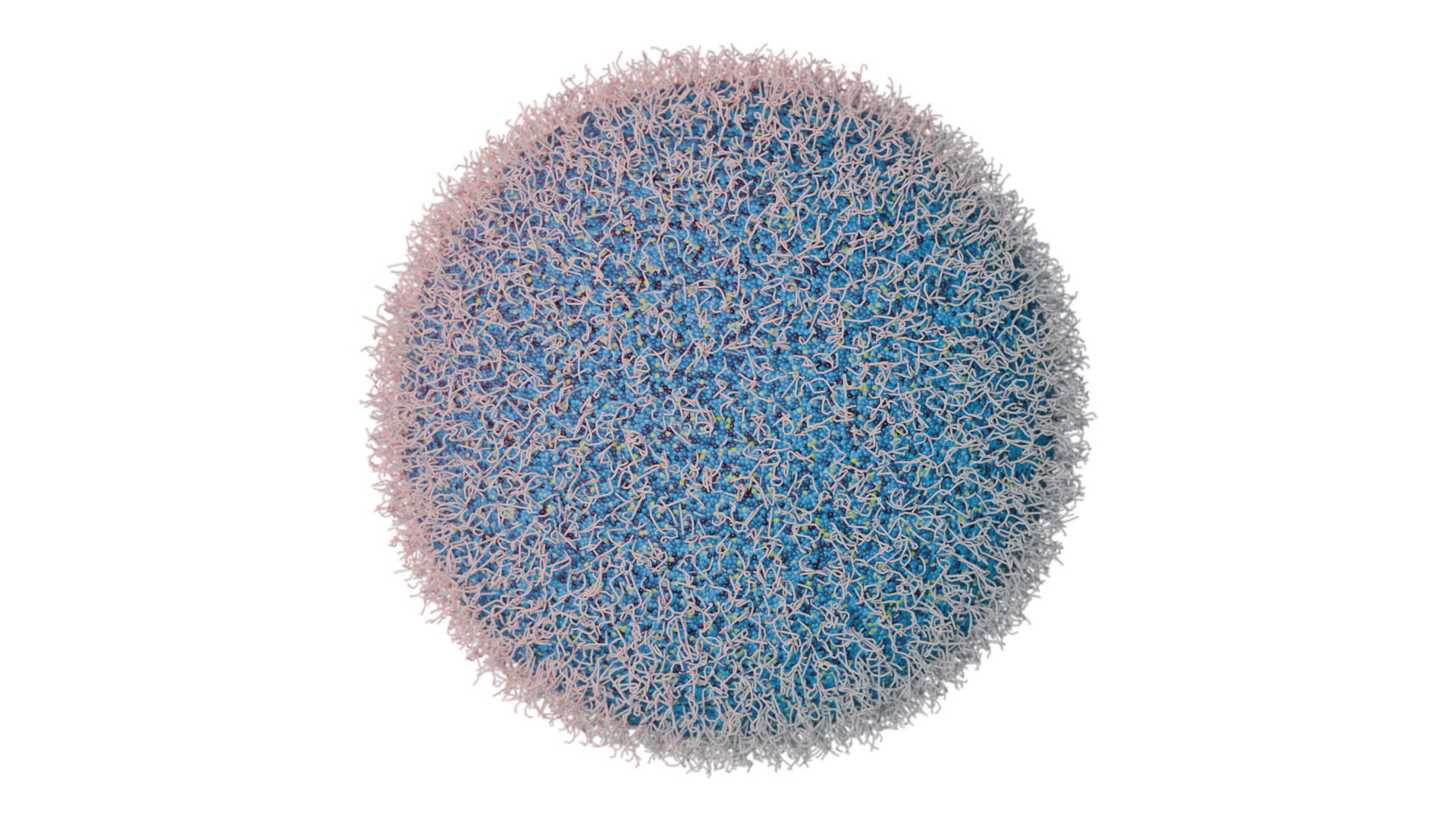
A lipid nanoparticle (LNP) is a ~100 nm drug delivery vehicle made from a mixture of lipids that can encapsulate and protect therapeutic cargo such as mRNA, siRNA, or DNA. LNPs are composed of four key lipid components, each serving a distinct function:
- Ionisable lipids—these are neutral at physiological pH but become positively charged in the acidic environment inside cellular compartments called endosomes. This charge switch is critical for releasing the cargo inside the cell.
- Helper lipids (such as DSPC or DOPE)—structural phospholipids that stabilise the nanoparticle bilayer and influence how the LNP interacts with cell membranes.
- Cholesterol—fills gaps between lipids, improving the structural integrity and stability of the particle.
- PEG-lipids—polyethylene glycol-conjugated lipids that sit on the outer surface, preventing LNPs from aggregating and providing a “stealth” layer that slows clearance by the immune system.
Together, these components form a stable particle that can encapsulate fragile nucleic acid payloads and protect them from degradation in the bloodstream before delivering them inside cells.
How do LNPs deliver drugs?
Once administered, LNPs circulate in the blood and are taken up by cells through a process called endocytosis—essentially, the cell membrane engulfs the nanoparticle and pulls it inside into a compartment called an endosome.
As the endosome becomes more acidic, the ionisable lipids in the LNP acquire a positive charge. This triggers the LNP to fuse with and disrupt the endosomal membrane, releasing the nucleic acid cargo into the cell’s cytoplasm. If the cargo is mRNA, it can then be translated by the cell’s own machinery to produce the encoded protein—whether that is a vaccine antigen, a therapeutic enzyme, or a gene-editing tool.
This mechanism was validated on a global scale by the Pfizer–BioNTech (Comirnaty) and Moderna (Spikevax) COVID-19 vaccines, which used LNPs to deliver mRNA encoding the SARS-CoV-2 spike protein.
The liver accumulation problem
Most LNPs delivered intravenously inherently target the liver—and this is not a coincidence. When LNPs enter the bloodstream, a layer of serum proteins rapidly adsorbs onto their surface, forming what is known as the protein corona.
This ApoE–LDLR interaction causes the vast majority of systemically administered LNPs to accumulate in the liver.
Not only does liver accumulation reduce the amount of drug reaching the intended target, it also raises safety concerns. Off-target delivery to hepatocytes can cause liver toxicity, particularly at higher doses.
Why targeted LNP delivery matters
To unlock the full therapeutic potential of LNPs, the field needs technologies that can redirect delivery away from the liver and towards specific cell types. The ideal solution would achieve two things simultaneously: active targeting to the desired cells, and active blocking of the default liver uptake pathway.
This is particularly important for emerging applications such as:
- In vivo gene therapy—delivering corrective genes or gene-editing tools to the specific cell populations affected by a genetic disorder, without causing liver toxicity.
Also has potential for HIV therapy. - Cancer immunotherapy—programming a patient’s own immune cells to recognise and attack tumours, by delivering mRNA encoding chimeric antigen receptors (CARs) directly to T cells in the body.
- Precision vaccines—targeting antigen-presenting cells or specific T-cell subsets to produce stronger, more focused immune responses.
- Autoimmune conditions—modulating specific immune cell populations to restore tolerance, without broadly suppressing the immune system.
Some approaches attempt to achieve targeting by modifying the LNP formulation itself or by chemically conjugating antibodies to the particle surface. However, formulation-based methods tend to redirect delivery at the tissue level without targeting specific cell types
How Hone Bio is solving this challenge
At Hone Bio, we have developed NanoPilot—a technology specifically designed to address both sides of the targeting problem. NanoPilot is an engineered fusion protein that can be applied to pre-formulated LNPs in a rapid, simple process. It simultaneously redirects LNPs to the target cell type and blocks the ApoE–LDLR interaction that would otherwise send them to the liver.
NanoPilot’s modular design means that different targeting antibodies can be incorporated to redirect LNPs to virtually any cell type of interest, making it a versatile platform for a wide range of therapeutic applications.
To learn more about how NanoPilot works, visit our technology page.
References
- Polack FP, et al. Safety and Efficacy of the BNT162b2 mRNA Covid-19 Vaccine. N Engl J Med. 2020;383(27):2603–2615. doi:10.1056/NEJMoa2034577
- Baden LR, et al. Efficacy and Safety of the mRNA-1273 SARS-CoV-2 Vaccine. N Engl J Med. 2021;384(5):403–416. doi:10.1056/NEJMoa2035389
- Adams D, et al. Patisiran, an RNAi Therapeutic, for Hereditary Transthyretin Amyloidosis. N Engl J Med. 2018;379(1):11–21. doi:10.1056/NEJMoa1716153
- Akinc A, et al. Targeted Delivery of RNAi Therapeutics with Endogenous and Exogenous Ligand-Based Mechanisms. Mol Ther. 2010;18(7):1357–1364. doi:10.1038/mt.2010.85
- Cheng Q, et al. Selective organ targeting (SORT) nanoparticles for tissue-specific mRNA delivery and CRISPR–Cas gene editing. Nat Nanotechnol. 2020;15:313–320. doi:10.1038/s41565-020-0669-6
- Hunter T, et al. In vivo CAR T cell generation to treat cancer and autoimmune disease. Science 2025;388, 1311–1317. doi:10.1126/science.ads8473
- Francia V, et al. The Biomolecular Corona of Lipid Nanoparticles for Gene Therapy. Bioconjugate Chem 2020;31(9), 2046–2059. doi:10.1021/acs.bioconjchem.0c00366
- Ung T, et al. Cell-targeted vaccines: implications for adaptive immunity. Front Immunol 2023;14 doi:10.3389/fimmu.2023.1221008
- Chen K, et al. Lung and liver editing by lipid nanoparticle delivery of a stable CRISPR–Cas9 ribonucleoprotein. Nat Biotechnol 2025;43:1445–1457. doi:10.1038/s41587-024-02437-3
- Cevaal P M, et al. Efficient mRNA delivery to resting T cells to reverse HIV latency. Nat Commun 2025;16 doi:10.1038/s41467-025-60001-2
- Björgvinsdóttir U J, et al. Targeting antibodies dissociate from drug delivery liposomes during blood circulation. J Control Release 2025;379:982–992 doi:10.1016/j.jconrel.2025.01.047